

Imperator Titan!

A little more about the design process...
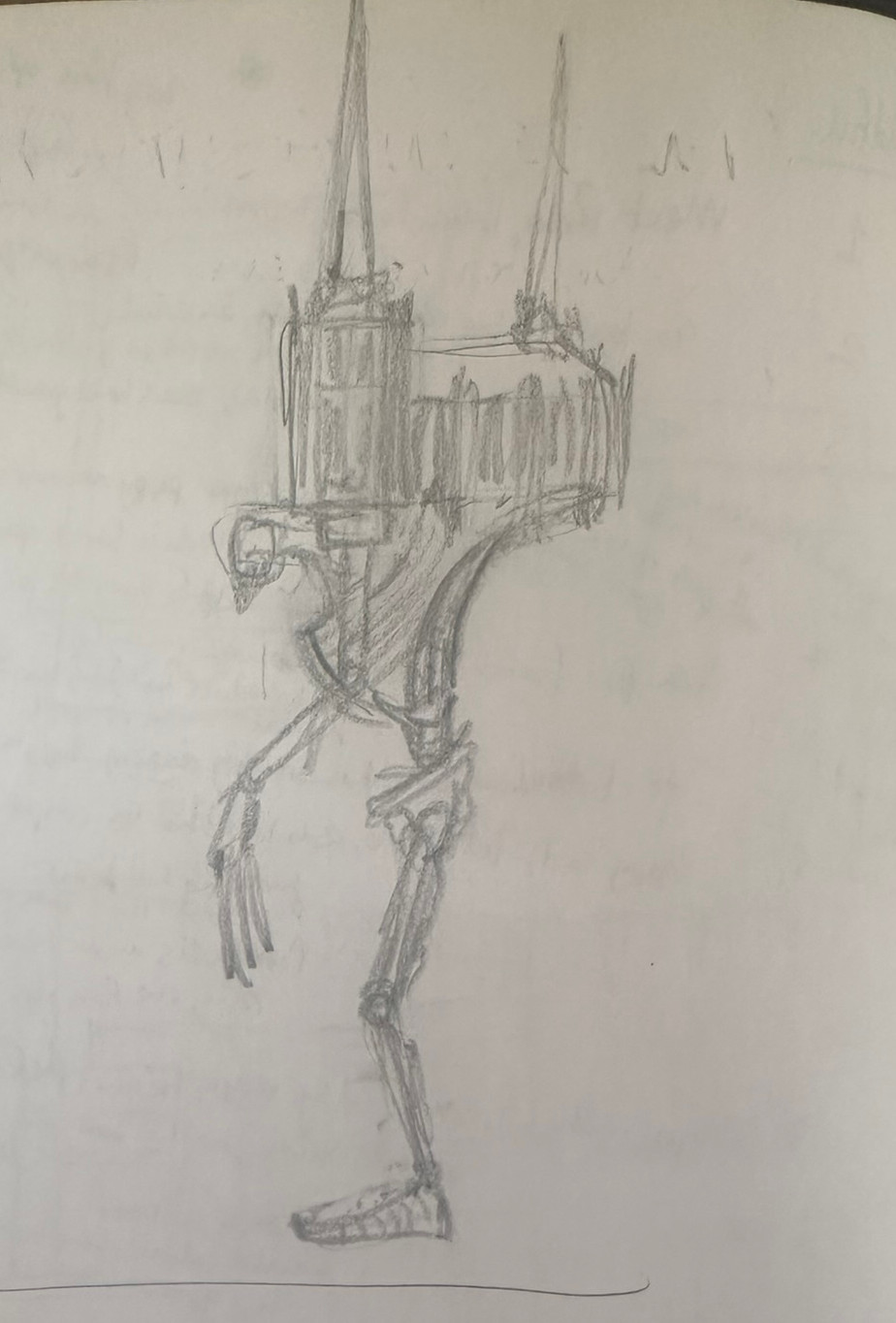
Here is the very first sketch I did of the titan. This was before I imagined it in the Warhammer universe, just a giant beast with a cathedral on its back. I liked the idea that under every cathedral is a sleeping giant and imagined what would it look like if it woke up.
When I decided to apply the design to the Imperator titan, the main ideas transferred across; like the hunched over posture carrying the great weight of the cathedral and the towers rising from the shoulders.
From the front, I wanted to make it look like a fortress, emphasizing the architectural aspect.

I was inspired by this painting of the Tower of Babel by Bruegel; the curved, terraced, impenetrable, monumental facade laced with the fine detail of the arches.
I also a took aspects of Wells Cathedral’s West towers, there is something about the geometry that feels chunky and mighty.

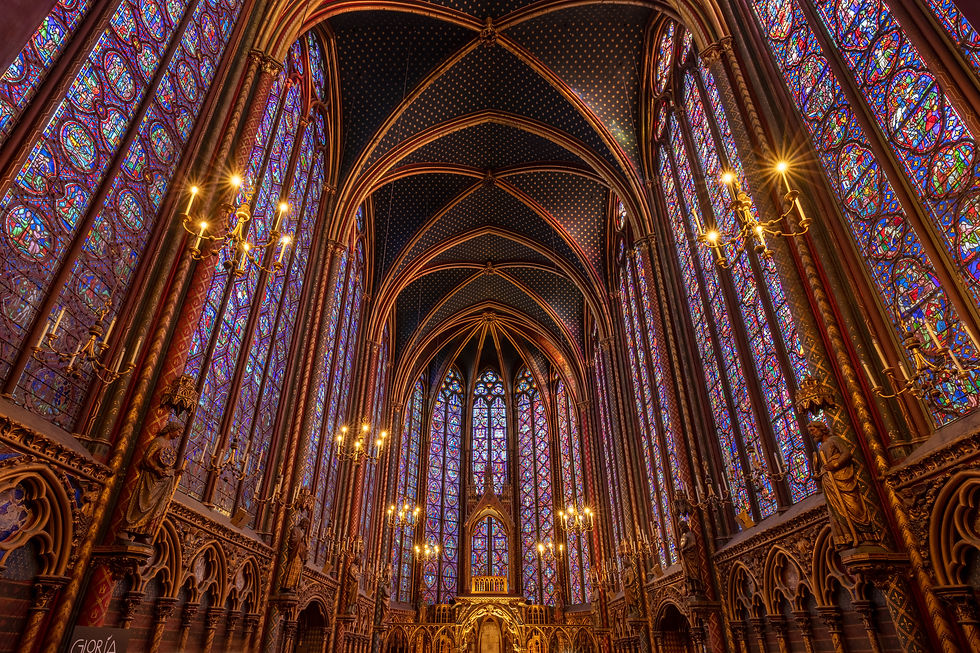
For the cathedral itself, it had to be relatively compact in order to sit on the shoulders of the mech. The obvious choice was Saint Chapelle in Paris. It is actually not a cathedral but a chapel built by Louis IX to house the relic of The Crown of Thorns. Whilst small in size, it is a jewel box of dazzling stained glass, and probably my favourite building in the world (Especially since I proposed to my wife there!)
Next step was to make a computer model.
I started with simple blocks to work out the overall shape of the titan. Computers are great for this since you can keep trying things and there’s no gravity to worry about. It’s cool to see how much of the final design was already in place.

Once I had a test model, I would then draw over it to see it with more detail. It’s a quick way to try stuff before investing too much time into the modelling.

From the beginning, the cathedral design was pretty clear to me. The difficult bit was to integrate the cathedral with the body of the mech. I tried mixing the Gothic details with the anatomy of a skeleton, like the spine and the shoulder blades, but it felt a bit arbitrary.

The solution came by returning to the original idea; being inspired by the great cathedral builders of the past.
Despite their visual complexity, Gothic cathedrals were designed using a simple ruler and a compass. All of the structural solutions came from this constraint.

For instance, the pointed Gothic arch. It is made by intersecting two circles. This was a revolutionary invention; unlike a rounded arch, the forces do not push out at the widest part as much. Additionally, the height of the arch could be adjusted by changing the distance between the radii. All this allowed the builders to build higher and higher.
Where the forces did push out, flying buttresses were added, creating a very strong latticework of stone still standing hundreds of years later. This ancient model of Milan Cathedral beautifully demonstrates it.

I realised that I must use the circle as a basis for all the design, from every Gothic arch to the curvature of the whole armoured facade.

The body carapace is circular, with another circle cut out of it to make the curve of its back, and on top of that spine is the most important part of the Cathedral; the rounded apse where the relic is held.

I also used actual flying buttresses to connect the shoulders. These were borrowed from Amiens Cathedral. I added them around the cathedral too. These were inspired by Beauvais Cathedral which I love for its pure audacity.

Beauvais had a wider influence too. They pushed the technology to it’s absolute limit with a ceiling vault that reached 48.5m! Part of it did collapse and the cathedral remains unfinished. Regardless, I wanted every aspect of the titan design to have this audacious spirit.
Once the model was complete, I posed it and got it ready to print.
It was very exciting to see my first print. It still feels like magic to me.

Here is a picture of all the parts.

I resisted putting it together at first since it’s easier to paint in bits. My wife suggested that I do test it, just to make sure it fits together before I spend time painting it.
I checked my reject bin and discovered that I could build nearly a whole model using these parts, only printing a few new bits.

I’m glad I did, when holding it together as the glue set, the whole thing twisted and fell apart, smashing to pieces on the floor. It reminded me a bit of Beauvais Cathedral…
I made all the necessary design changes, beefing up the hips and waist joints, carrying out a few wobble tests and the model was ready to be painted.
In my mind, I imagined the structure to be stone coloured, evoking the ancient cathedrals. Dirty too, blackened with age.
But also with colour, just like the medieval cathedrals used to be. Red as the main colour with highlights of blue and lots of gold.
I imagined these great machines to be extremely rare and valuable. I wanted it to shimmer in gold as it caught the light. That’s one thing about the past I love, everything from armour to warships were finely decorated; fighting a war of aesthetic finesse too.

Painting was the toughest part of the project, feeling the consequences of so enthusiastically adding tiny details everywhere.
It took ages, nearly brought me to my knees but I’m thrilled with the result.
I feel particularly happy that all of that intense looking at the hundreds of cathedrals I’ve dragged my wife around has had some outlet.
But most of all, when building something like this, learning how cathedrals were built, I can savour the genius of our ancestors.


